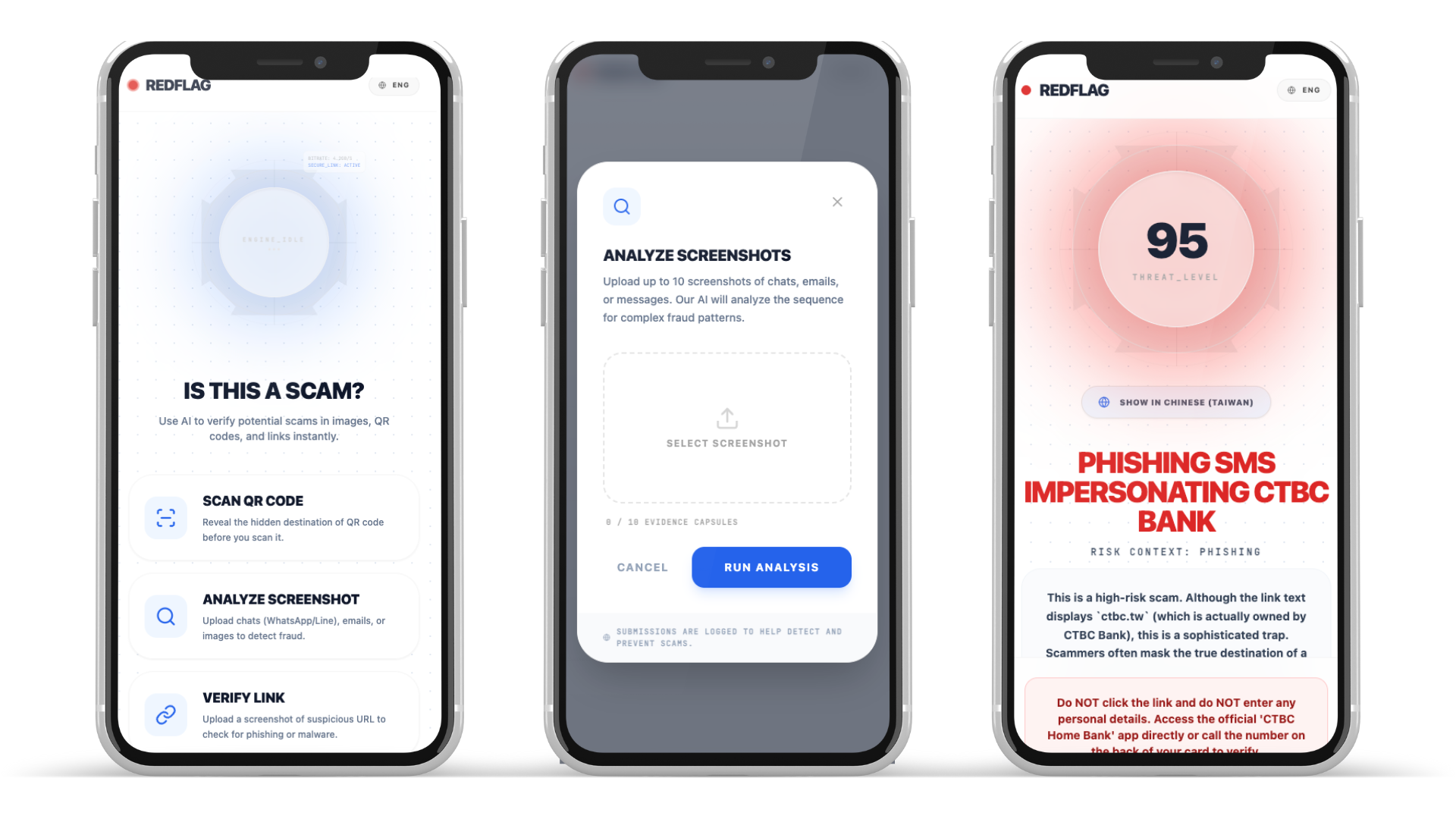
Fraud is rampant. The US loses approximately US$34 million daily to scams; in Taiwan, the figure is US$8–9 million. Scam tactics are everywhere — and AI is helping bad actors become more sophisticated, more convincing, and harder to detect.
If AI is making offense better, we need to make defense better too. That’s why I created RedFlag — a threat detection and risk assessment tool that puts the power of AI-driven scam analysis directly into the hands of everyday consumers.
What It Does
RedFlag is a universal fraud detector. Screenshot a suspicious message or URL, or scan a QR code — an agentic Gemini investigation runs real security tools behind the scenes (WHOIS, DNS/GeoIP, Google Safe Browsing), then cross-references the technical evidence against the content’s claims to surface red flags.
RedFlag explains fraud through a 3-step narrative: the hook (what lured you), the MO (how the scam operates), and the risk signals (the technical evidence that proves it). Every fact shown in the UI — domain age, registrar, server location, registrant — comes from real API data, not model generation. The app works in 8 languages and auto-detects the user’s locale.
Drawing from my experience as a fraud analyst — building risk frameworks, fraud rules, and data infrastructure for enterprises — I mapped the consumer scam landscape into three core threat types:
- Phishing Links — Fraudulent URLs designed to steal credentials or personal data by impersonating trusted websites, from crude fakes to near-perfect replicas of banking portals and government services.
- QR Code Scams — A growing attack vector where malicious links hide behind QR codes. The consumer sees a seemingly legitimate code on a poster, in a message, or at a payment terminal, but scanning it redirects them to a phishing site.
- Social Engineering Scams — Scams delivered through conversation: chat messages, SMS, emails, paper mail, or in-app messages. These rely on psychological manipulation — urgency, authority, fear, or trust — rather than technical exploits, making them the hardest to detect and the most damaging.
How I Built It
- Frontend: React 19 + TypeScript SPA with Vite, Tailwind CSS, and Framer Motion
- Backend: Vercel serverless functions with a single
/api/analyzeendpoint - AI: Gemini Interactions API (agentic multi-turn loop) — Gemini autonomously decides which security tools to call, executes them in parallel, then reasons across all results to produce a bilingual fraud analysis
- Intelligence Tools: 4 backend tools (DNS/GeoIP, RDAP with registrar referral chain, Google Safe Browsing, homograph detection) that Gemini calls as needed
- Trust Layer: Server-side
buildVerifiedFromToolResults()constructs a verified data object from raw tool output, completely independent of the model’s JSON response - Logging: Supabase for fire-and-forget analysis logging and user feedback tracking
- i18n: Custom React Context provider with 8 locale files and browser language auto-detection
Challenges I Ran Into
Reliable phishing detection. I discovered that WHOIS data and other publicly available domain intelligence can be used reliably for detection — domain age, registrar history, and hosting location tell a story before you ever load the page.
Building a unified analysis pipeline. I initially built three separate API calls for each feature. Then I realised that these three checks are inherently similar — a URL is a URL whether it was typed, scanned from a QR code, or extracted from a screenshot. Switching to the Gemini Interactions API’s agentic capabilities let the model decide which tools to call, eliminating redundant code and producing smarter, more context-aware analysis.
Designing for global users. A user’s language and location are independent from the scam’s language and origin. A Singaporean travelling in Taiwan might encounter a Chinese-language fraud but still want to read the analysis in English — or in Chinese. The solution was dual-language output: analyse in the scam’s native language for accuracy, then present in the user’s preferred language for clarity.
What I’m Proud Of
From manual rules to agentic orchestration. Traditional fraud detection requires understanding each category of fraud, learning its patterns, then manually creating data features or ML models to detect them. With RedFlag, the paradigm shifts — orchestrating an AI agent with the right tools means the system can reason across fraud categories rather than being hard-coded for each one.
The 3-step fraud narrative. Hook, MO, and risk signals make fraud understandable to non-technical users. It’s not a risk score — it’s a story that teaches people how scams actually work, with actionable next steps they can take immediately.
Geo-mismatch detection. Cross-referencing server hosting country against registrant country against the brand being impersonated catches sophisticated phishing that no single check would flag.
The verified data layer. Gemini reasons about fraud, but the Digital Fingerprint grid shows only real data from actual API responses. This separation means users never see hallucinated facts — a “registered 3 days ago” claim is provably true.
Screenshot-first input. Asking someone to paste a suspicious link — and risk accidentally clicking it — defeats the purpose. This was a design decision rooted in user safety.
Dual-mode fallback. The Interactions API is in beta and can fail. I built a complete legacy path using generateContent that shares the same system prompt, response schema, and verified data pipeline — so if the agentic path errors, users still get a full analysis without knowing anything went wrong.
What I Learned
- Agentic AI is a paradigm shift. Letting the model drive tool selection produces smarter, more adaptive analysis than pre-calling everything or routing through separate APIs.
- Open infrastructure is underrated. Free tools like IANA RDAP, DNS-over-HTTPS, and GeoIP databases can replace expensive commercial threat intel APIs for most fraud detection use cases.
- Security hygiene matters in consumer apps. Moving API keys from client-side to server-side, implementing rate limiting, and supporting multi-language output were all lessons learned through building rather than theory.